
Paper bowl denesting problems occur when nested bowls do not separate consistently for packing, filling or use. Investigate the finished bowl, the stack and the receiving operation together. Compare geometry, surface contact, storage history and the position of each failure within a traceable stack before changing forming settings. A bowl that separates easily by hand immediately after manufacture may behave differently after packing and storage. This guide proposes a practical qualification plan for formed paper bowls; it does not specify a universal separation force, stack height or feeder setting, and it does not establish food-contact compliance.
Define what successful separation means
Start with the actual receiving operation. Will an operator remove bowls by hand, will a dispenser release them, or will an automatic feeder present one bowl at a time? Record the required outcome in those terms. A test based on hand separation alone cannot prove reliable automatic feeding. Similarly, a successful demonstration on one feeder does not establish compatibility with every customer installation.
Identify the bowl drawing, material construction, coating, seam arrangement and intended packaging. Retain a signed reference sample and photographs of a normal stack. Describe unacceptable events clearly: two bowls released together, no release, a distorted rim, a torn surface or an interruption requiring manual intervention. Counting all of these as simply difficult feeding loses information needed to find the cause.
The Realstar paper cup and bowl machine is relevant to the upstream forming stage. Its product listing does not establish the compatibility of a finished bowl with a particular customer’s denester. That requires samples made with the ordered tooling and materials, then tested through the intended handling and receiving arrangement.
Preserve the stack as received
Label sleeves or cartons with production lot, forming setup, packing time and storage history where available. Photograph the stack before pulling it apart. Record whether it was upright, inverted, compressed or otherwise constrained in its packaging. Keep one representative sample unopened while another is used for examination. This preserves evidence if the initial test changes the way the stack behaves.
Do not separate and restack every bowl before conducting an as-received test unless that preparation is part of the customer’s normal operation. Pre-separation can remove the condition under investigation. If a second test uses restacked bowls, label it as a separate condition and compare the results rather than replacing the original observation.
Also retain bowls from different positions in a sleeve. A problem concentrated at one end may be associated with packing, local damage or an uneven load, while a recurring pattern across the stack may suggest another cause. These patterns guide subsequent trials but are not proof on their own.
Distinguish surface sticking from mechanical nesting
Examine separated bowls for coating transfer, fiber damage, contact marks and rim deformation. A tight geometric engagement and adhesion between contacting surfaces can both resist separation, but they call for different follow-up. Record what you can observe without assigning a cause too early. Preserve matched bowl pairs when a particular contact area appears to be involved.
A technical paper hosted by TAPPI discusses blocking tests for coated paper substrates. It describes how testing conditions and separation measurements affect the evaluation of coated surfaces. That supports treating surface sticking as a separate material question. Flat substrate testing is not a validated substitute for a finished-bowl denesting test, and this article does not transfer its laboratory results into a bowl acceptance limit.
If surface adhesion is suspected, involve the coating or board supplier with representative samples and a documented history. If geometric locking is suspected, compare the formed article with the approved drawing and discuss tooling and forming variation with the machine supplier. Do not add powders, lubricants or other substances to food-contact packaging as an informal troubleshooting step.
Build a comparison that changes one condition
Use the following proposed decision table to organize the first investigation. The observations are intended to identify the next question, not to diagnose a machine component without inspection. Agree numerical limits, sample quantities and test conditions with the parties responsible for the finished package and receiving equipment.
| Observed event | Useful comparison | Record to preserve |
|---|---|---|
| Two bowls release together | As-received stack versus a separately identified restacked sample | Event count and positions within each stack |
| Visible surface transfer or fiber damage | Matched contact areas and material lot history | Photographs and paired retained bowls |
| Rims become distorted during separation | Incoming rim condition versus condition after handling | Before-and-after samples linked to the event |
| Failures concentrate near a sleeve end | Stack orientation, packing contact and neighboring sleeves | Packing photographs and position map |
| Hand separation works but automatic feeding fails | Actual feeder interface and production-representative stack | Feeder configuration and recorded operating events |
| Fresh bowls pass but stored bowls fail | Traceable storage and packing histories | Time, conditions and unopened comparison samples |
Avoid changing material, forming setup and packing simultaneously. A better comparison states the hypothesis, changes one agreed condition and predicts what evidence would support or weaken it. Keep the original baseline available so an apparent improvement can be challenged against a repeat run.
Check the formed bowl before changing a feeder
Inspect dimensions and shape using the approved drawing and measurement method. Compare samples from different times within the run. Look for consistent relationships between the sidewall, bottom and rim rather than relying on a single overall height. Record any irregularity at the seam or other repeated location so it can be compared with contact marks in the stack.
The following image comes from the Realstar bowl machine’s product gallery and shows its rim-forming arrangement. It identifies a relevant production stage, but the photograph does not prove the cause of a particular nesting defect. Any tooling or setting change requires the machine supplier’s instructions and a subsequent full product check.
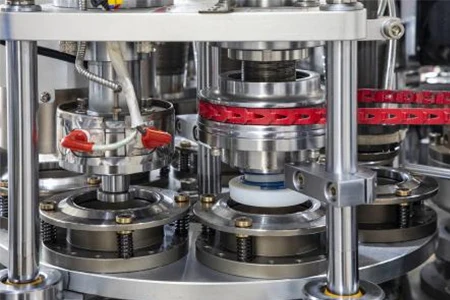
When a forming change is proposed, preserve the previous approved recipe and identify the trial output separately. Check that the change has not introduced leakage, rim damage or another unacceptable condition. Use the paper bowl bottom leak testing guide and the paper bowl side seam leak guide for complementary investigations, keeping their acceptance criteria separate from denesting.
Include packing and storage in qualification
A qualification plan should cover the actual journey from forming to use. Document the packing method, sleeve orientation, storage period and any transport or handling stage selected for the trial. Do not invent a severe test and present it as a standard requirement. Instead, agree representative conditions with the customer and material supplier, then record exactly what was done.
Test both the condition received by the customer and any preparation the customer routinely performs. Count the labor and interruptions associated with that preparation. If successful feeding requires every sleeve to be manually loosened, record that requirement explicitly so it is included in the operational decision. A demonstration that silently adds extra preparation overstates the readiness of the packaged product.
Keep any unusual exposure, damaged carton or missing history visible in the results. An unknown storage condition is a limitation, not an opportunity to assign a convenient cause. Where evidence is incomplete, collect a traceable new comparison rather than declaring the original lot acceptable from an unrelated fresh sample.
Verify the receiving equipment with actual bowls
For an automatic feeder, provide the supplier with the exact bowl drawing, production samples, stack photographs and the intended delivery packaging. Ask how it will be supported, separated, picked and released. Record the approved setup and its permitted range. Changes to gripping or support contact must preserve the bowl’s shape and its later closing or filling function.
Observe the stack through a planned run, including replenishment and the low-stack condition where relevant. Distinguish a missing release from a double release and record what the operator did to recover. Report acceptable output and interruptions together. A short video of easy samples is useful for communication but does not replace a representative acceptance sequence.
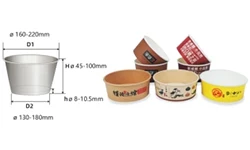
This second gallery image shows bowl dimensions and finished bowl examples for product context. Its annotations describe the website illustration, not the acceptance limits for your job. No downstream feeding equipment is represented as an included accessory. Confirm the actual scope of supply separately when purchasing a forming line and a feeding or packing system.
Keep machine access and package hygiene controlled
Do not reach into moving forming or feeding equipment to pull apart a jammed stack. Follow the installed machine’s safe clearing procedure and use competent personnel when isolation or maintenance is required. The HSE machinery maintenance guidance explains the need to control energy and plan safe access. Its principles support the investigation; the local procedure and machine instructions determine the actual steps.
The WorkSafeBC video below provides supplementary education about guards and lockout in manufacturing. It does not authorize an operator to bypass a guard or improvise a clearing method. Keep inspected packages protected from contamination, and segregate damaged or handled trial pieces according to the site’s quality procedure.
WorkSafeBC: guards and lockout in manufacturing.
Create a release record the customer can use
Summarize the bowl specification, material lot, forming configuration, packing arrangement, storage history and receiving equipment. State how many events were observed and under which conditions. Include unsuccessful trials and unresolved observations, not only the final successful sequence. Retain representative samples so later production can be compared with the accepted condition.
If the finished bowl also uses a lid, verify that denesting and handling have not damaged the closing interface. The separate paper cup lid fit testing guide explains why the container and lid should be evaluated together. Approval of separation performance does not establish leak resistance, food-contact suitability or lid security; those need their own evidence for the intended use.
FAQ
Does easy hand separation prove automatic denesting will work?
No. Hand separation is a useful preliminary observation, but automatic performance depends on the actual bowl, stack, packaging and receiving equipment. Test production-representative samples on the intended arrangement.
Are bowls sticking because of their coating?
Coating-related blocking is one possible cause, but geometric engagement or damage can also resist separation. Inspect matched surfaces and shape, retain the storage history and involve the material and equipment suppliers before changing the process.
Should every stack be loosened before acceptance testing?
Test stacks as received first unless loosening is an agreed normal production step. If preparation is required, document its labor and effect, then keep prepared and unprepared results separately identified.