
UV screen printing curing and adhesion are related quality checks, but one does not replace the other. A print can resist a particular tape test without independently demonstrating the required cure, and a cured ink can still bond poorly to an unsuitable surface. Investigate them as separate questions using the ink supplier’s approved methods and the installed curing system’s documentation. Start with identified substrate and ink lots, the printed construction and repeatable sampling points. This guide explains how to organize a practical acceptance trial for sheet-fed packaging work without inventing a universal lamp setting, exposure time or pass criterion.
Define the two acceptance questions
Cure verification asks whether the ink or varnish has undergone the required reaction under the specified process conditions. Adhesion verification asks whether the printed layer remains attached under a defined test. The selected tests must match the actual ink, substrate and use. A complaint that the print “comes off” needs a more precise description before anyone changes the press or curing line.
Record whether the observed failure is visible immediately, after the agreed waiting period, during stacking or after a later finishing operation. Photograph the test area and retain the removed sample or tape where the method calls for it. Mark the side and location on the sheet. A single unlabeled photograph of a peeled patch cannot show whether different trials were tested at the same time or in the same way.
Ask the ink supplier which method is suitable for evaluating cure and which method evaluates adhesion on the intended surface. Specify who interprets uncertain results. Do not substitute touching the print, scratching it with a fingernail or judging its odour for an approved release decision. Those informal observations do not define a reproducible acceptance test or establish safety for the intended application.
Identify the whole printed construction
Record the substrate grade, supplier, lot and printing face. Include any coating, laminate, foil or earlier print layer. A material described only as “plastic sheet” or “silver board” leaves important surface differences unresolved. Obtain the substrate supplier’s identification and recommended handling conditions before treating a new delivery as equivalent to the accepted reference. Keep an unprinted sample for investigation where practical.
Record the exact ink or varnish designation, batch, storage history and any supplier-authorized additions. Keep the technical sheet and safety data sheet with the job record. An additive should not be introduced simply because it improved a different ink on another substrate. If a formulation or preparation changes, ask the supplier which cure and adhesion checks must be repeated before production is released.
For multilayer work, identify the sequence and each layer’s specified curing step. A clear top layer does not automatically establish the condition of the colour beneath it. Include artwork version and coverage in the trial record. A small light-coloured patch can be an inadequate substitute for the production image if the latter presents a different printed construction. Select representative test areas with the responsible ink specialist.
Distinguish the printing machine from the curing arrangement
The Realstar fully automatic flat-bed screen printing machine is described for sheet printing and connection with downstream equipment, including curing arrangements. Confirm what the quoted and delivered line actually includes. A printing-machine listing alone does not identify the lamp technology, exposure conditions or validated ink system for a particular installation.
Document the installed curing unit, lamp type, control names and the relevant operating record. Keep lamp maintenance history and any approved measurement data with the trial. A controller percentage is not a measured exposure at the printed surface. Do not compare unidentified percentages between systems or infer that the same conveyor speed gives the same result on two different lines.

SID Leipzig’s UV printing information explains why measurement needs to suit the source and actual production conditions. It also describes sources of variability in tape adhesion assessment. Use that distinction to ask for a suitable measurement method, rather than copying a numerical cure threshold from an unrelated application. A qualified laboratory or ink specialist may be needed when routine checks leave the result uncertain.
Make the adhesion test repeatable
Obtain a written test procedure before comparing trial sheets. Depending on the agreed method, the record may need the tape identity, application conditions, waiting period, removal method and assessment area. Follow the supplied procedure precisely rather than combining parts from several tests. If a customer specifies a recognized method, confirm the applicable version and any agreed sample preparation with the responsible parties.
Label the time between printing and testing. Compare samples at equivalent stages and under the same agreed conditions. If one trial is tested immediately and another much later, a difference cannot safely be attributed only to the lamp setting. Keep a control sample and identify any deviation from the procedure. An operator’s description of “strong tape” is insufficient to reproduce the comparison.
Record where separation occurs where the approved method allows that interpretation. Material may separate at the substrate interface, between printed layers or within a coating. These are different observations. Retain samples for the supplier instead of concluding that every removed fragment proves insufficient UV exposure. A change that improves one interface may still leave a different part of the construction unacceptable.
Use a decision table without guessing the cause
| Observation | Record to retain | Next question | Unsupported shortcut |
|---|---|---|---|
| Adhesion result changes between operators | Test procedure, tape identity and sample age | Was the method performed consistently? | Change lamp power before checking the test |
| One substrate lot differs | Lot identity and unprinted retained stock | Is the approved surface construction unchanged? | Assume all sheets with the same trade name are equivalent |
| One sheet area repeatedly fails | Marked artwork and test-location map | Are print construction and exposure uniform there? | Judge the whole sheet from one convenient patch |
| Top layer remains while another separates | Layer sequence and retained failure sample | At which interface did separation occur? | Treat all peeling as the same cure defect |
| Result changes after maintenance | Service record and complete trial conditions | Which approved process conditions changed? | Release production from controller readings alone |
This is an investigation plan rather than a list of proven causes. The actual cure and adhesion release criteria must come from the approved ink-substrate application and customer requirements. Keep both test results in the job record, even if only one originally triggered the complaint.
Change the process through an agreed trial
Begin with a documented approved condition or obtain the suppliers’ recommended starting procedure. Define the single authorized variable being compared. Keep the substrate, ink preparation, artwork and test method consistent where possible. If screen preparation or the deposited layer changes at the same time as the curing condition, record the combined change and avoid attributing the result to exposure alone.
Include representative positions across the sheet and samples from the agreed production sequence. Compare results at startup and during the defined confirmation run. If a problem appears only after stacking or a later finishing step, preserve samples from before and after that step. A pass at the curing-line exit does not independently release the complete downstream route when the order requires further processing.
Use instruments only through the maker’s approved handling and measurement procedure. Any measurement that requires access to a curing enclosure must be planned by trained personnel. Never defeat covers or interlocks to obtain a reading or visually check the lamp. Refer abnormal output, damaged shielding or unreliable controls to qualified service personnel before continuing the trial.
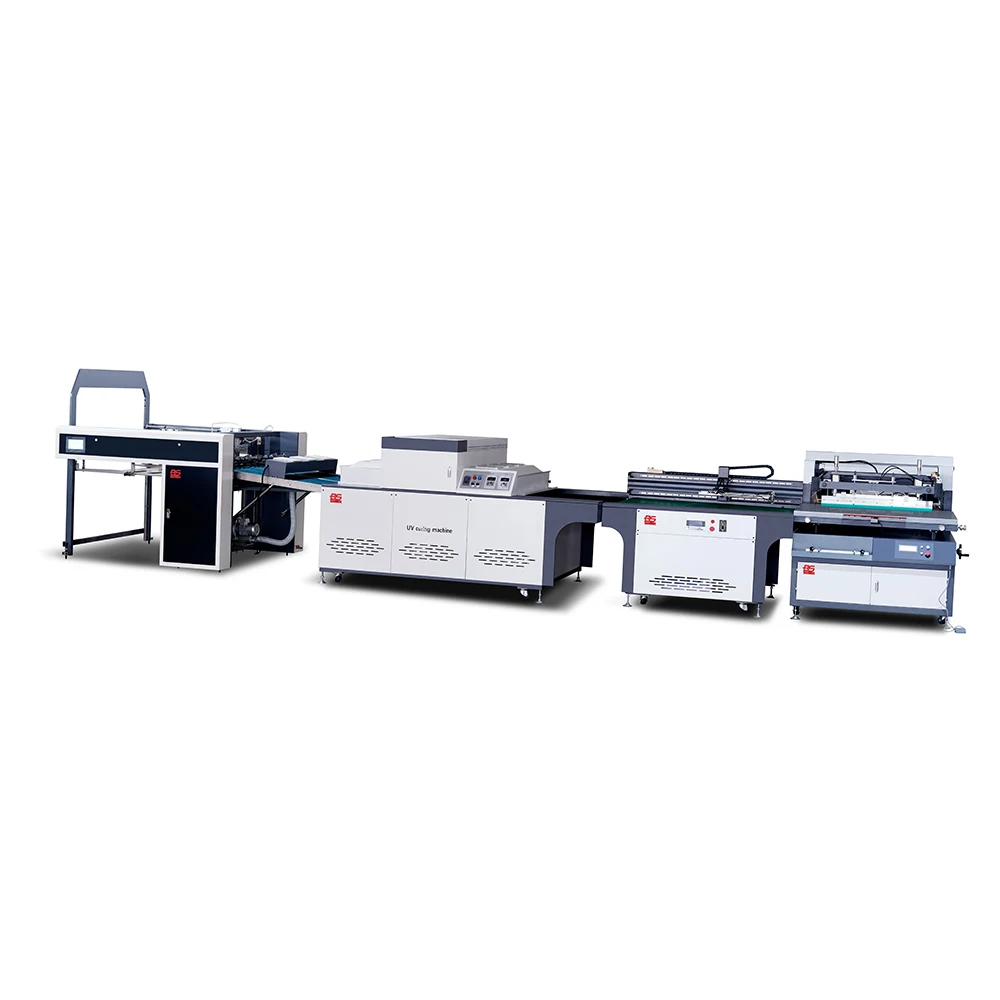
The two accompanying body photographs show separate Realstar screen-printing configurations. They illustrate the need to identify the actual supplied machine, rather than imply that all models share one curing line. The Realstar equipment range can help organize a discussion of the complete process. Confirm integration, controls and responsibility for acceptance in the written proposal.
Treat handling safety as part of the process
EuPIA’s guidance on energy-curing inks and varnishes identifies contact and exposure concerns and directs users to product-specific safety information. Build the job’s handling, cleaning and protective-equipment procedure from the actual safety data sheet and workplace assessment. Do not infer that a dry-looking sample establishes safe contact conditions for every use.
HSE’s UV-curable printing guidance specifically addresses lithographic arrangements where curing lamps generate ozone. Its screening and exposure-control context is useful, but the installed screen-printing system needs its own assessment. Confirm the lamp technology and extraction requirements; do not automatically apply an ozone assumption or a ventilation number to every UV LED installation.
The following WorkSafeBC training covers manufacturing guarding and lockout. It is relevant to interventions around the press and downstream line, not to ink chemistry or a cure test. Keep cleaning, sample collection and maintenance within the supplied equipment procedures, with the appropriate isolation and chemical handling controls.

Watch WorkSafeBC guards and lockout training on YouTube.
Include downstream finishing and the intended use
List what happens after printing: stacking, cutting, creasing, lamination or another finishing stage. Identify the approved checkpoints and the order’s functional expectations. A surface that passes an agreed adhesion test before a later operation may still require inspection afterwards. Use the thermal lamination troubleshooting guide for complementary finish issues and the hot foil stamping defects guide for a separate decorating process.
For packaging with regulated end uses, obtain the appropriate application documentation from the ink, substrate and converting partners. Neither an adhesion test nor a machine demonstration independently establishes food-contact suitability or migration compliance. Keep those release decisions with the qualified responsible parties and the relevant application evidence. Do not use a general printing capability statement as a certification claim.
Build a useful handover record
The accepted record should connect the machine and curing-unit identities, substrate and ink lots, artwork, approved conditions, test procedures and results. Include retained samples and the people responsible for interpreting exceptions. State which substitutions or maintenance changes require requalification. A new ink, surface treatment or lamp arrangement should not silently inherit the previous job’s approval.
When requesting service or a quotation, send this record with the intended sheet range and finishing route. Ask who supplies the cure verification method, who approves the ink-substrate combination and how the acceptance trial will demonstrate the complete line. Keep unresolved results visible rather than selecting only the strongest-looking test sample. That makes the final decision traceable and gives production a reference for the next run.
Frequently asked questions
Does a successful tape test prove complete UV curing?
No. Tape adhesion is one defined performance assessment. Use the ink supplier’s approved cure verification method separately and document both results for the actual substrate and printed construction.
Can the same lamp percentage be copied between machines?
Not as an equivalent exposure. Identify the lamp system, control meaning and approved measurement method. Controller percentages alone do not establish what reaches the printed surface on a different line.
Should every peeling defect be treated by increasing exposure?
No. First verify the adhesion method, identify the separating interface and review material and print construction. Make only supplier-authorized changes through a controlled comparison that checks cure and adhesion independently.